27 June 2005
Periodic Report due 1 July 2005
Periodic (quarterly) reports are due from sub-award grantees of the Capacity Partnership Project, Compassion Capital Fund by end of business on Friday, 1 July 2005. Please be sure to submit your on time, by email, to me or Carla. If you need a report form, call me. I am looking foward to reading your report.


26 June 2005
Dr. Carver, is the job of the board an easy one?
". . .we all know that simple and easy are not the same thing. Many things are simple in their expression, yet difficult to achieve. Pilot, we want the plane on the runway with the rubber parts down. Surgeon, we want a working kidney. Explorer, we want a new route to China. Researcher, we want a cure for cancer. We want the homeless in housing. We want the hungry well-fed. We want world peace. We want a person on the moon who returns safely to earth. We want a chicken in every pot.
"Those aims are simply expressed, but by no means easy. Simplicity does not enable us to expect effortlessness. And difficulty in no way detracts from importance."
From a speech given at the 2nd Annual Conference, "Good Governance in Action", of the International Policy Governance Association, June 3, 2005.
Make a litte progress every day
Last week I was with a client who said something like this:
That is not an exact quote, but you get the picture. When I first met this client, she was discouraged and thought it always had to be that way. Their proposal was all about computer hardware that would have solve some specific issues but not the core of the matter. With a lot of discussion and revision we found a way to get a consultant who could sit down with this executive director, understood her situation, and helped her make progress.
Do you need this kind of help? Keep watching this space for information about next year's Capacity Partnerhsip Progect program.
We have made more progress in the last few months working on this project than I could have imagined. We had a hard time conceptualizing what capacity building is. You helped us find a consultant that understood me, understands our culture, the nature of our organization, and the unique situation we are in. And, now we are moving forward. We have found resources that we didn't know existed before. I have been personally encouraged. The tools that the consultant has provided are priceless. Thanks for sticking with us.
That is not an exact quote, but you get the picture. When I first met this client, she was discouraged and thought it always had to be that way. Their proposal was all about computer hardware that would have solve some specific issues but not the core of the matter. With a lot of discussion and revision we found a way to get a consultant who could sit down with this executive director, understood her situation, and helped her make progress.
Do you need this kind of help? Keep watching this space for information about next year's Capacity Partnerhsip Progect program.
23 June 2005
People tell me things that should be repeated!
The purpose of this new blog is to get some information about the work of the Capacity Partership Project out to the rest of our organizational clients. Some of the feedback I get, and the things that I learn from our clients is well worth repeating! You should be a part of it. Keep checking out the blog for more information.
22 June 2005

16 June 2005
Funding Opportunity: Workforce Investment Act
Welcome back! From MEDA's research team at the home office.
Workforce Investment Act—Limited English Proficiency and Hispanic Worker Initiative
Proposals due 15 August 2005 to the Department of Labor (DOL)
This link will begin the download of a .pdf (1.7 MB), the RFP announced today by the Employment and Training Administration. The grant focuses on providing literacy and jobs skills training to Hispanics. It seems like a fairly involved grant with several partners required, but the grant is big $500,000 -- $ 1 million. Maybe one of the CDCs would be able to apply. Here is the link if you need to copy and paste it into your browser.
http://a257.g.akamaitech.net/7/257/2422/01jan20051800/edocket.access.gpo.gov/2005/pdf/05-11881.pdf
Workforce Investment Act—Limited English Proficiency and Hispanic Worker Initiative
Proposals due 15 August 2005 to the Department of Labor (DOL)
This link will begin the download of a .pdf (1.7 MB), the RFP announced today by the Employment and Training Administration. The grant focuses on providing literacy and jobs skills training to Hispanics. It seems like a fairly involved grant with several partners required, but the grant is big $500,000 -- $ 1 million. Maybe one of the CDCs would be able to apply. Here is the link if you need to copy and paste it into your browser.
http://a257.g.akamaitech.net/7/257/2422/01jan20051800/edocket.access.gpo.gov/2005/pdf/05-11881.pdf
Executive Summary: The U.S. Department of Labor, Employment and Training Administration (ETA), announces the availability of approximately $5 million in demonstration grant funds to test unique and innovative training strategies for services to individuals with Limited English Proficiency (LEP) (those who do not speak English as their primary language and who have a limited ability to read, speak, write, or understand English 1 ) and Hispanic Americans, specifically, those who lack basic and occupational skills needed by high-growth occupations. This demonstration program is targeted to incumbent workers, new job entrants or youth who lack the language, basic skills, and occupational skills necessary to succeed in the 21st century workplace. This demonstration program emphasizes the use of innovative contextualized learning strategies which simultaneously provide language and occupational skills training that open career opportunities and pathways for LEP and Hispanic Americans.
The Limited English Proficiency (LEP) and Hispanic Worker Initiative is a strategic effort to improve access to employment and training services for LEP persons and to better serve Hispanic Americans through workforce investment programs that address the specific workforce challenges facing these individuals. Grant funds awarded under this Solicitation for Grant Applications (SGA) should be used to develop unique and innovative strategies that specifically address the workforce challenges of LEP individuals and Hispanic Americans. Applications must reflect a strategic partnership between the public workforce investment system, the employer community, the education and training community, and, if applicable, community-based or faith-based organizations. It is anticipated that individual awards will fall within the range of $500,000 to $1 million. The Department reserves the right to award grants at either lower or higher amounts.
12 June 2005
Bank of America Neighborhood Excellence Initiative
Last year, Los Angeles Capacity Partner Susan Burton of A New Way of Life was a 2004 Neighborhood (S)Hero and Centro Campesino in south Florida was Neighborhood Excellence Initiative recipient.
Good News! The program is back!
To learn more about the program and for details on the application process, click here
Nomination Deadline: June 30, 2005 8PM Eastern
Good News! The program is back!
The 2005 Bank of America Neighborhood Excellence Initiative is underway. Through this unique program, qualified organizations can apply to be awarded $200,000 in unrestricted general operating support to further the work of their organization.
PLEASE NOTE: RECEIVING FUNDS FROM THIS PROGRAM DOES NOT PRECLUDE YOUR ORGANIZATION FROM OBTAINING ADDITIONAL FUNDS FROM THE BANK OF AMERICA FOUNDATION.
The Neighborhood Excellence Initiative is designed to recognize and reward
individuals and groups who are making a difference in their communities,
and is divided into three categories of recipients:
- Neighborhood Builders - Provides $200,000 in grant funding and leadership training over two years to two neighborhood non-profit organizations working to promote vibrant neighborhoods.
- Local Heroes - Recognizes and honors five community heroes per year; recipients will be able to direct a $5,000 contribution to an eligible non-profit of their choice.
- Student Leaders - Recognizes five high school students who are recommended as exemplary young people with an interest in improving their neighborhoods. Each student will participate in an eight-week paid internship with a community-based organization, as well as a mentoring program arranged by Bank of America.
To learn more about the program and for details on the application process, click here
Nomination Deadline: June 30, 2005 8PM Eastern
03 June 2005
Eight Principles of the Heroic Environment
These are the shared principles that govern organizations consulted by Mr. Lebew and articulated in his book, The Journey into the Heroic Environment. It is another in the series of books on leadership that help organizations create an environment to move forward to accomplish its outcomes or ends.
- Treat others with uncompromising truth.
- Lavash trust on your associates.
- Be willing to mentor, and be open to mentoring from anyone.
- Be receptive to new ideas, regardless of their source.
- Take personal risks for the organization's sake.
- Give credit where credit is due.
- Be honest and ethical in all matters.
- Put the interests of others before your own.
01 June 2005
International Policy Governance Association
I will be in Scottsdale, Arizona at the International Policy Governance Association second annual conference, Good Governance in Action June 2-4, 2005. I am looking forward to seeing old friends and making new ones at this conference.
I will also have the opportunity to visit with Dennis Beatty of First Baptist Church of Prescott to chat about Policy Governance and its application in church settings.
UPDATE: Someone asked how many people are attending. The answer is about 200.
I will also have the opportunity to visit with Dennis Beatty of First Baptist Church of Prescott to chat about Policy Governance and its application in church settings.
UPDATE: Someone asked how many people are attending. The answer is about 200.
25 May 2005
Governance questions and issues from AEO conferees
Welcome back!
In a seminar at the Association of Enterprise Opportunity, I asked those in our group to define what issues and questions they have about board governance. We used these as starting points for hitting the important issues of governance and specifically, Policy Governance (r).
I'll address these and other issues here. We provide day long training for boards and consulting to create and install consistent and comprehensive policies at the board level.
Your ideas matter here! Please leave a comment.
In a seminar at the Association of Enterprise Opportunity, I asked those in our group to define what issues and questions they have about board governance. We used these as starting points for hitting the important issues of governance and specifically, Policy Governance (r).
- We are a new organization and we are wrestling with building a program and establishing policies and procedures that support smart, sustained growth.
- How do you get the board to do what it is supposed to do (manage the board, bring awareness to organization, fundraise, legal oversight, financial oversight . . . ) and not what it isn't supposed to do?
- How to have a board not managed by the executive director?
- Forming a new board, how do we establish distinct functions for board members and staff?
- We are re-organizing a dysfunctional board--there are inappropriate board members, original stakeholders whose relevance has been passed by.
- How is the board to deal with issues of --staff compensation, board stipends, broad range development vs narrow range development, board size.
I'll address these and other issues here. We provide day long training for boards and consulting to create and install consistent and comprehensive policies at the board level.
Your ideas matter here! Please leave a comment.
16 May 2005
Questions and Issues from the AEO conference session on Board Leadership Governance Excellence
In a seminar at the Association of Enterprise Opportunity, I asked those in our group to define what issues and questions they have about board governance. We used these as starting points for hitting the important issues of governance and specifically, Policy Governance (r).
I'll address these and other issues here. We provide day long training for boards and consulting to create and install consistent and comprehensive policies at the board level.
- We are a new organization and we are wrestling with building a program and establishing policies and procedures that support smart, sustained growth.
- How do you get the board to do what it is supposed to do (manage the board, bring awareness to organization, fundraise, legal oversight, financial oversight . . . ) and not what it isn't supposed to do?
- How to have a board not managed by the executive director?
- Forming a new board, how do we establish distinct functions for board members and staff?
- We are re-organizing a dysfunctional board--there are inappropriate board members, original stakeholders whose relevance has been passed by.
- How is the board to deal with issues of --staff compensation, board stipends, broad range development vs narrow range development, board size.
I'll address these and other issues here. We provide day long training for boards and consulting to create and install consistent and comprehensive policies at the board level.
12 May 2005
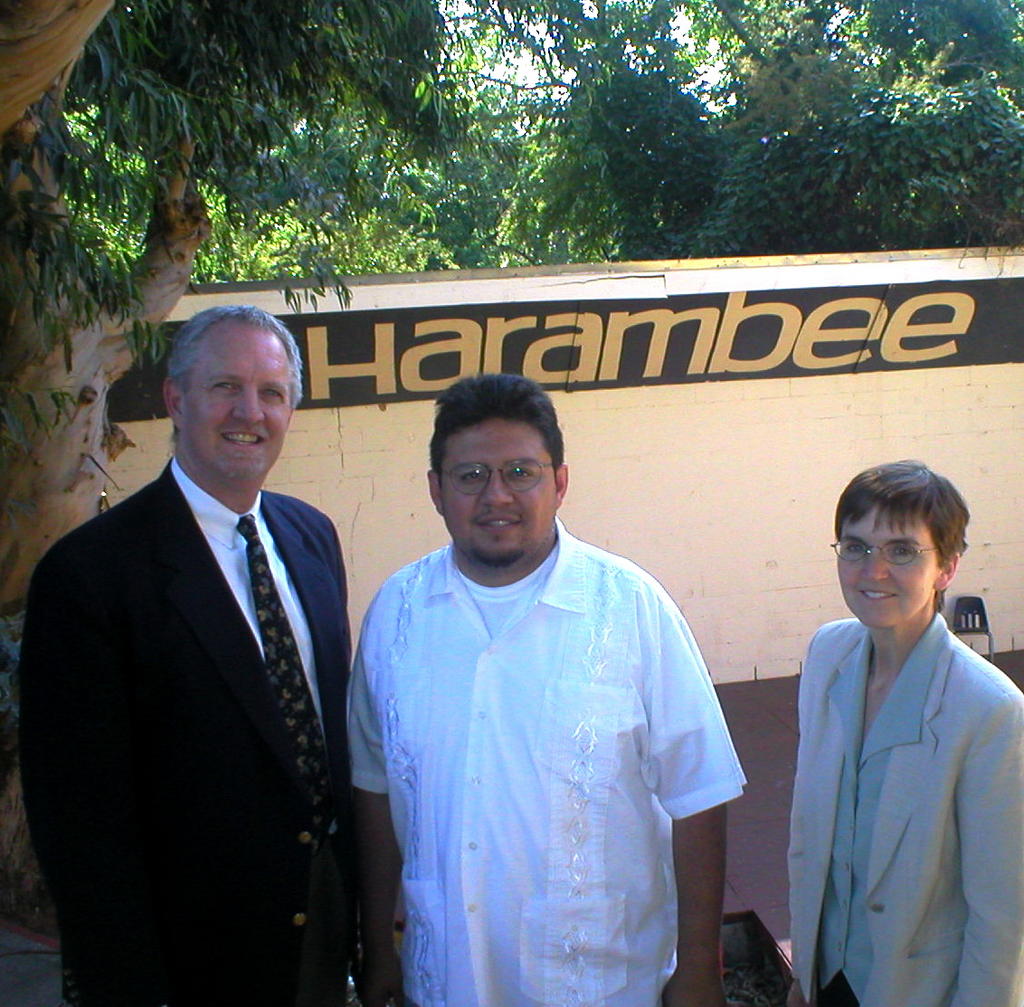
Harambee in NW Pasadena
 Welcome back!
Rachel and I visited many of the projects together. I really didn't wear the suit that often, we must have visited a bank or a funder on this same day.
Here Rudy Carrasco of Harambee is showing us around the center. MEDA provided support to help their board of directors make some good decisions for a great future for Harambee Christian Family Center and Harambee Prepatory School.
Harambee reorganized the board, defined its role in relationship to the executive director, and combined resources with a related organization that shares the same facility. Rudy told me that the work with the consultant helped him and the board get on the same page in a significant way.
Your ideas matter here! Please leave a comment.
23 February 2005
The Consultant
Welcome back!
Glen Peterson is regional manager for Mennonite Economic Development Associates’ capacity building project for CDCs and economic development organizations in south Florida, Los Angeles, Chicago, and Indianapolis.
Glen is a member of the International Policy Governance® Association and trained with John and Miriam Carver at the Policy Governance® Academy. Peterson provides technical assistance to adopt and install a complete board governance system that links an organization to its moral ownership, holds it accountable to accomplish what it should and avoid unacceptable situations.
For fifteen years he was the executive director of a community-based organization that provides microenterprise training, financial literacy and traditional employment programs in south Los Angeles.
Your ideas matter here! Please leave a comment.
Glen Peterson is regional manager for Mennonite Economic Development Associates’ capacity building project for CDCs and economic development organizations in south Florida, Los Angeles, Chicago, and Indianapolis.
Glen is a member of the International Policy Governance® Association and trained with John and Miriam Carver at the Policy Governance® Academy. Peterson provides technical assistance to adopt and install a complete board governance system that links an organization to its moral ownership, holds it accountable to accomplish what it should and avoid unacceptable situations.
For fifteen years he was the executive director of a community-based organization that provides microenterprise training, financial literacy and traditional employment programs in south Los Angeles.
Your ideas matter here! Please leave a comment.
14 February 2005
Taxpayer Education Programs from State BOE Chairman John Chiang
State Board of Equalization Chairman John Chiang periodically hosts taxpayer
education programs for his constituents. These programs are held for small
business owners, non-profit and religious organizations, as well as specific
industry groups. Chairman Chiang's taxpayer education programs bring
representatives from a variety of federal, state, and local tax agencies
together to help individuals, businesses, and organizations better
understand their federal, state, and local tax compliance obligations. The
programs are especially helpful to individuals, organizations, and small to
medium sized businesses who feel overwhelmed by all of the complex tax laws
and tax reporting requirements.
Past topics have included: (1) Social Security Benefits & Small Business
Owners; (2) Raffle Reporting and Pre-Registration Requirements; (3) State
and Federal Payroll Tax Reporting and Depositing Requirements; (4) Home
Based Businesses; (5) Audits and Appeals; (6) Record Keeping Obligations;
(7) State Income Tax and Small Businesses; (8) The Difference Between an
Employee or Independent Contractor; (9) How to Start a Small Business; (10)
Financing Your Small Business; (11) General Sales and Use Tax Reporting
Requirements; (12) How to Prepare a Sales and Use Tax Return; (13) Sales Tax
for Construction Contractors; (14) Property Tax Exemptions.
Within the next few weeks, Chairman Chiang is hosting a Free California Tax
Amnesty Informational Panel Discussion to inform his constituents about the
California Tax Amnesty Campaign that began February 1, 2005 and continues
through March 31, 2005. More information about Chairman Chiang's California
Tax Amnesty Panel Discussion will follow shortly.
We have found that these taxpayer education programs are most successful
when Chairman Chiang partners with a local community based organization to
host a particular event. Programs are typically scheduled at least six to
eight weeks in advance and draw, on average, seventy-five to one hundred
fifty attendees. The number of attendees varies depending on the
organization, program location, etc.
education programs for his constituents. These programs are held for small
business owners, non-profit and religious organizations, as well as specific
industry groups. Chairman Chiang's taxpayer education programs bring
representatives from a variety of federal, state, and local tax agencies
together to help individuals, businesses, and organizations better
understand their federal, state, and local tax compliance obligations. The
programs are especially helpful to individuals, organizations, and small to
medium sized businesses who feel overwhelmed by all of the complex tax laws
and tax reporting requirements.
Past topics have included: (1) Social Security Benefits & Small Business
Owners; (2) Raffle Reporting and Pre-Registration Requirements; (3) State
and Federal Payroll Tax Reporting and Depositing Requirements; (4) Home
Based Businesses; (5) Audits and Appeals; (6) Record Keeping Obligations;
(7) State Income Tax and Small Businesses; (8) The Difference Between an
Employee or Independent Contractor; (9) How to Start a Small Business; (10)
Financing Your Small Business; (11) General Sales and Use Tax Reporting
Requirements; (12) How to Prepare a Sales and Use Tax Return; (13) Sales Tax
for Construction Contractors; (14) Property Tax Exemptions.
Within the next few weeks, Chairman Chiang is hosting a Free California Tax
Amnesty Informational Panel Discussion to inform his constituents about the
California Tax Amnesty Campaign that began February 1, 2005 and continues
through March 31, 2005. More information about Chairman Chiang's California
Tax Amnesty Panel Discussion will follow shortly.
We have found that these taxpayer education programs are most successful
when Chairman Chiang partners with a local community based organization to
host a particular event. Programs are typically scheduled at least six to
eight weeks in advance and draw, on average, seventy-five to one hundred
fifty attendees. The number of attendees varies depending on the
organization, program location, etc.
05 February 2005
Little Haiti Housing Association
 Sam Diller, Executive Director of Little Haiti Housing Association greets MEDA board member during a tour of the south Florida Capacity Partership Project sites. MEDA subaward helped LHHA plan and start a home ownership conversion project.
Your ideas matter here! Please leave a comment.
04 February 2005
Little Haiti Housing Association and Miami Dade Neighborhood Housing
 . . . hosted the MEDA board of directors as they toured CCF projects in south Florida as part of their board meetings.
Pictured here is Howard Good, MEDA Vice President, North American Opporations; Leoni Hermantin, Board Chair, Little Haiti Housing Association and director of Sant La Little Haiti Neighborhood Center; and Arden Shank, Executive Director, Miami Dade Neighborhood Housing
Your ideas matter here! Please leave a comment.
Kids programs at Peacemakers Center at Trinity Church
 Welcome back!
Trinity Church has a lot of programs going on through its Peacemaker Center. These pre-schoolers are enjoying a hot lunch during their school day.
Your ideas matter here! Please leave a comment.
20 November 2004
Local Hero Susan Burton

Welcome!
MEDA Capacity Partnership Project participant Susan Burton of A New Way of Life Re-entry Project, was awarded the Neighborhood Hero Award by Bank of America. She is pictured here near the center in pink with here board of directors. Congratulations Susan from all of us.
Your ideas matter here! Please leave a comment.
Subscribe to:
Posts (Atom)